Ghanaian founder turns his family’s drought loss into insurance for farmers
...Derrick Awumey drew on personal adversity to build a company that helps smallholder farmers anticipate climate losses and insure against them. Now an award-winning business with a team of young co-owners, AgriCom Assurance operates in Ghana and Rwanda.

Derrick Awumey was in his final year at university when drought destroyed his family’s crops. The lost harvest left his tuition unpaid, and he was unable to sit his final examinations.
Today he is the founder and chief executive officer of AgriCom Assurance, a Ghanaian company that uses satellite monitoring, weather forecasting and artificial intelligence (AI) and voice technology in over 27 languages, to bring insurance and early warnings to smallholder farmers in Ghana and Rwanda.
“When our family lost our crops to drought, it was not simply an agricultural loss. It affected our household income, my education, and our family’s financial stability,” says Awumey. “That experience taught me that when a farmer loses a harvest, the consequences can affect an entire family’s future.”
Protection before the loss:
Awumey studied biomedical engineering, and he says that the discipline taught him to treat technology as a tool for solving human problems. His research into agricultural insurance convinced him that a payout after a disaster was too little, and that farmers needed timely information that could help them to avoid losses in the first place.
“This is why we have never wanted AgriCom to be just another insurance company offering compensation after a disaster,” he says. “We want to help farmers prevent avoidable losses through weather information, early warnings, agricultural advisory services, and access to appropriate financial protection.
“A farmer should not need an expensive smartphone, advanced literacy skills, or a sophisticated understanding of insurance terminology to access protection.”
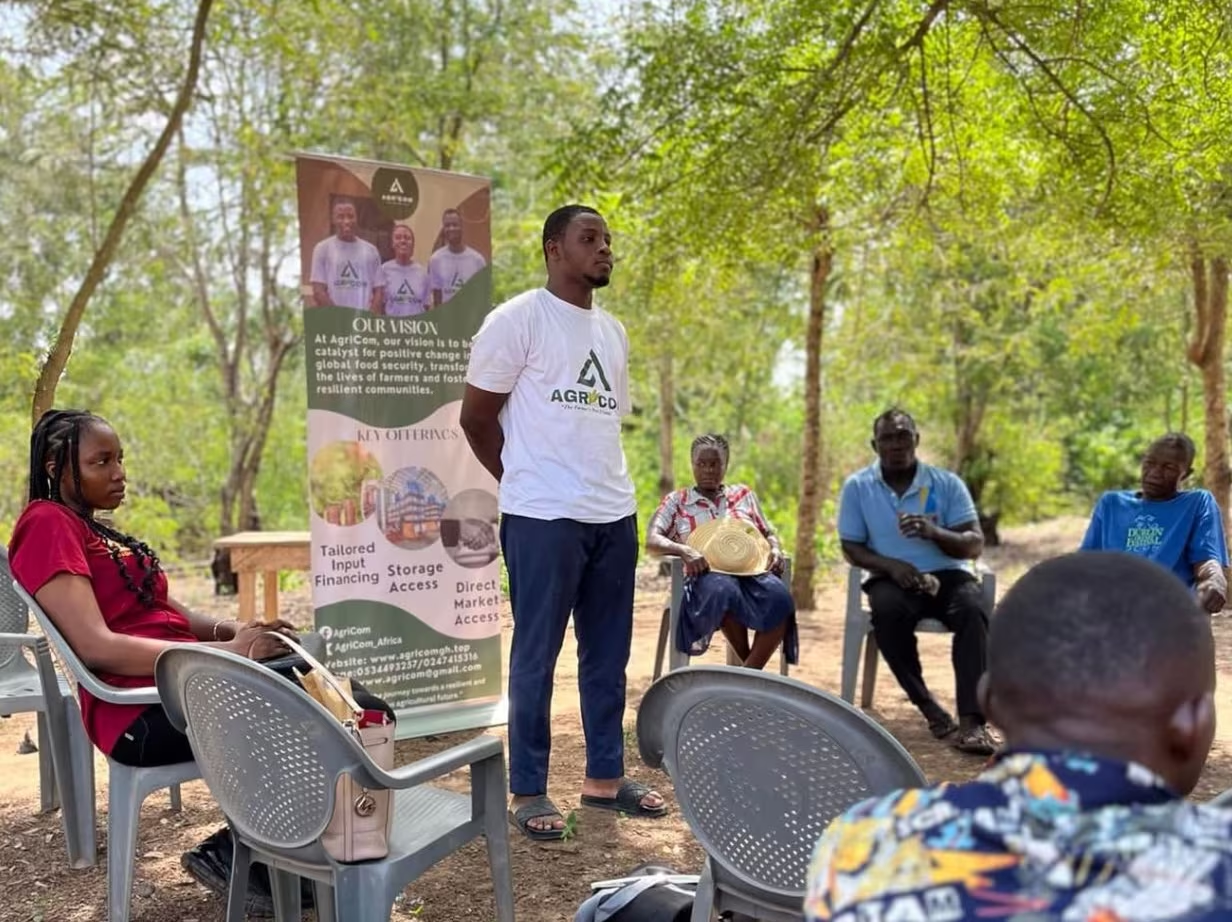
AgriCom is developing services that use familiar communication channels, local languages and community-based agents. Awumey says that his own history shapes the way that he speaks to farmers. “I see my mother, my grandmother, and the many farming families whose livelihoods depend on the next harvest,” he says. “I understand why some farmers are sceptical about insurance and why they need to trust the people offering them financial products.”
From a mission to a company
Awumey joined the ALX Founder Academy with a clear sense of the problem and little structure for building a business around it. ALX is a pan-African technology and entrepreneurship training provider from which more than 352,000 young Africans have graduated.
“One of the biggest lessons was learning to separate my emotional attachment to the problem from the commercial realities of solving it,” he says. “Just because a problem matters deeply to you does not automatically mean you have developed a sustainable business model around it.
“I also learned that as a founder, my responsibility was not simply to have all the ideas or make every decision. It was to build a team, establish systems, and develop an institution that could function and grow beyond me.”
AgriCom could not afford to hire the software developers and data professionals that it needed, and Awumey recruited young professionals through an internship programme organised by ALX to support young start-ups such as AgriCom. Some of them stayed on and now hold equity in the company.
“For me, equity represents more than compensation. It is about ownership, trust, and building something together,” he says. “It has taught me that Africa does not lack talent. Sometimes, what talented young people lack is an opportunity, someone willing to believe in them, and an environment where they can take ownership of something meaningful.”

Recognition after rejection
Awumey says that he faced repeated rejection from competitions, investors and potential partners before any recognition came. Since 2024, AgriCom has won innovation competitions run by institutions in Ghana’s banking and insurance sectors, and in 2025 it took first place in the ALX Do Hard Things Challenge.
“Winning was incredibly emotional because I knew how far this journey had taken us,” he says of the Do Hard Things final in Rwanda. “I remembered the competitions we had lost, the unanswered emails, and the moments when I questioned whether anyone would ever truly understand what we were trying to build.”
While funding and credibility opened doors with institutions, Awumey is measured about what prizes can do. “Awards can attract attention, but only execution can sustain it,” he says. “We cannot tell farmers that our company has won several competitions and expect that to solve their problems. Ultimately, our success must be measured by the number of farmers we are able to protect, the losses we help them avoid, and the financial security we help them build.”
Two markets and the next steps
Operating in Ghana and Rwanda has shown Awumey that regulation, farming practices and customer behaviour differ from one country to the next. “What works in Ghana cannot simply be copied and implemented in Rwanda without understanding the local context,” he says. “Perhaps the biggest lesson from our expansion is that scaling across Africa requires not only a good product, but patience, local knowledge, strong institutions, and the humility to adapt.”
AgriCom’s priorities are to strengthen its Farmer Management System, to distribute insurance through the cooperatives, input suppliers and financial institutions that farmers already use, and to attract strategic investment. Additionally, the team have obtained additional voice technology datasets that will bring the total to 45 languages when in the new models.
With the expansion to Rwanda and obtaining a sandbox license in Zambia, AgriCom has secured 23 strategic partners and raised approximately US$150,000, with potential reach extending to over three million farmers across Africa.
Innovation through adversity
Awumey has advice for founders who, like him, started a business to solve a problem that they experienced personally. “Be stubborn about the problem you want to solve, but flexible about how you solve it,” he says. “Surround yourself with people who challenge you, not just people who applaud you.”
He also urges founders to “build relationships before you need them”, which he does by staying in touch with the founders and professionals that he met through ALX.
“Sometimes it is about sharing an opportunity, discussing a difficult business decision, exchanging ideas, or simply encouraging another founder who is going through a challenging season,” he says. “One thing I value about the ALX network is that it reminds you that you are not building in isolation.”
Awumey wants young founders to understand that success is not always immediate. Sometimes it can take years working on something before receiving validation. This time is valuable, he says, because a founder uses it to develop the knowledge, character, relationships and resilience required to handle the opportunities that eventually come.
Awumey’s final advice is that adversity, however painful, can be a powerful driver of innovation and opportunity. “When I look back at the drought that affected my family and prevented me from sitting my final examinations, I realise that one of the most painful experiences of my life ultimately gave birth to the mission I pursue today.”